Summary:
Blanks (pre-made garments from suppliers like Gildan, Bella+Canvas, or AS Colour, then decorated and relabelled) are the right answer for many brands on day one: low minimums, fast lead times, and little cash at risk while you test whether a design sells. Cut and sew means building the garment from fabric up, which costs more at small volumes but unlocks proprietary fit, fabric weight, silhouettes, trims, and color control that blanks never can. The usual best path is sequential: validate demand on blanks, then move proven styles into cut and sew once repeat purchases, sell-through, fit complaints, and margin pressure say it’s time.
Two Founders, Two Expensive Lessons
The first founder launches a hoodie on a popular blank, prints a good graphic on the chest, and sells out in three weeks. Pleased, she reorders. Then she notices three competitors selling nearly identical hoodies, the same body, same fit, same fabric, and different print. Her only lever left is the artwork. Fit complaints trickle in, and she can’t fix them, because the blank’s cut isn’t hers to change.
The second founder skips blanks entirely. He builds a custom hoodie from scratch, spends 12 weeks and around $8,000 on patterns, samples, and a first run, and discovers the silhouette he fell in love with doesn’t sell. The money is in inventory; he can’t move it.
Both made a reasonable decision with the information they had. Neither got neutral advice, because most of what’s written on this topic comes from print-on-demand platforms with an obvious reason to recommend blanks. This guide lays out the comparison with the numbers side by side, concedes where blanks win, and explains where they stop being enough.
What Each Model Actually Is
Blanks are finished, undecorated garments from established suppliers (Gildan for budget, Bella+Canvas for a softer retail feel, and AS Colour for a fashion-forward fit). You add decoration, such as screen printing, embroidery, or heat transfer, and often relabel them with your own neck label so the garment reads as yours. The garment itself, its fabric, cut, and construction are the supplier’s.
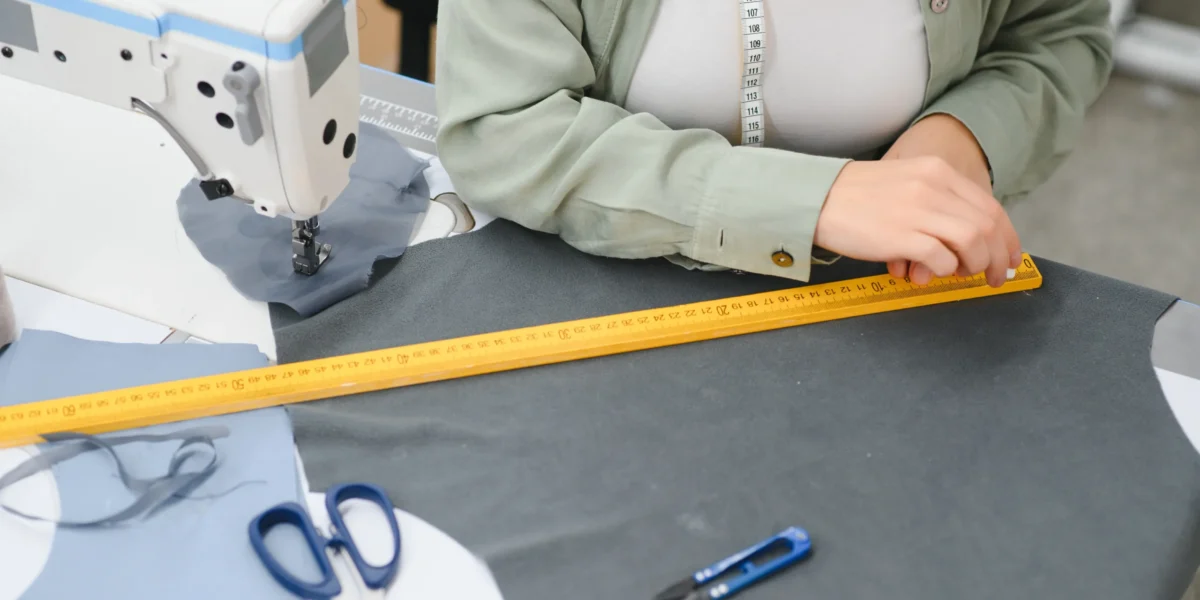
Cut and sew means producing the garment from raw fabric: pattern making, marker making (laying out pattern pieces on fabric to minimize waste), fabric sourcing, cutting, sewing, and finishing. Every decision, from fabric weight to seam placement to trims, is yours. That control is the whole point, and it’s also where the cost, time, and risk come from.
The Straight Comparison
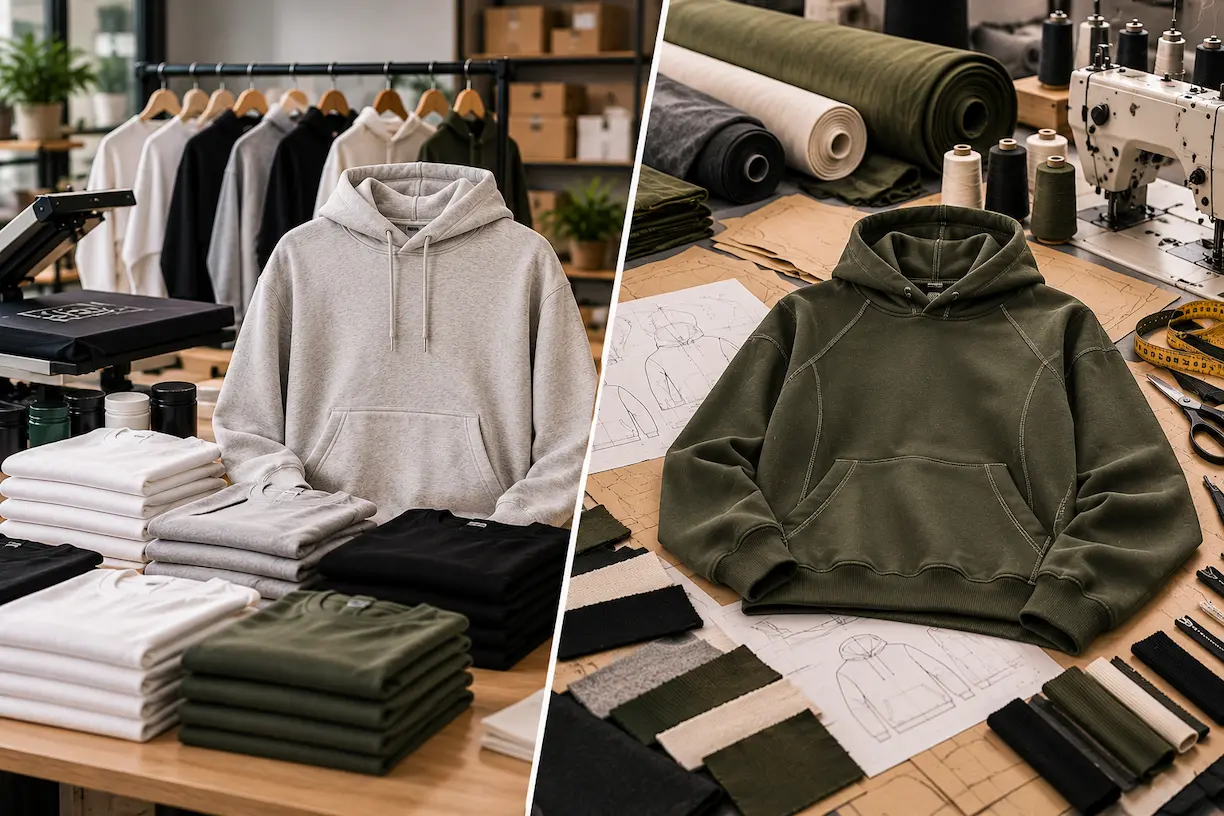
| Factor | Blanks + Decoration | Cut and Sew |
| Typical MOQ | As low as 1-50 units | Commonly 100-300 per style/color |
| Lead time | Days to 2-3 weeks | 8-14 weeks from first sample |
| Upfront cash (100 hoodies) | Roughly $2,900 | Roughly $4,700, including development |
| Differentiation | Artwork and label only | Fit, fabric, silhouette, trims, color |
| Fit control | None | Full |
| Risk if design fails | Low | Meaningfully higher |
| Best for | Validating demand | Scaling a proven product |
Neither column wins outright. They’re built for different stages, which is the point most comparisons miss.
Margin Per Unit: A Hoodie at 100 and 1,000 Units
Here’s an illustrative comparison of a single hoodie retailing at $75. These are representative figures built from typical market ranges, not quotes, so treat them as a model to rebuild with your own numbers.
Assumptions: blank cost drops with volume ($24 at 100 units, $20 at 1,000 for a premium blank); one-color screen print costs $4 at 100 and $2.50 at 1,000; relabelling and packaging add $0.60. Cut and sew is quoted all-in at $38 per unit at 100 and $22.50 at 1,000, plus a one-off development cost of $900 (patternmaking, grading, samples) spread across the run.
| Blanks, 100 units | Cut and sew, 100 units | Blanks, 1,000 units | Cut and sew, 1,000 units |
|
| Cost per unit | $28.60 | $47.00 | $23.10 | $23.40 |
| Gross profit per unit | $46.40 | $28.00 | $51.90 | $51.60 |
| Gross margin | 61.9% | 37.3% | 69.2% | 68.8% |
| Total upfront spend | $2,860 | $4,700 | $23,100 | $23,400 |
The pattern is clear. At 100 units, blanks win decisively: cut and sew’s fixed development cost lands on too few garments. By 1,000 units, the margins are essentially level, because the cut-and-sew clothing unit price falls sharply as development costs and fabric minimums are absorbed.
And here’s what the table doesn’t show: at equal margin, the cut and sew garment is yours alone. A heavier fabric or a distinctive fit often supports a higher retail price. If the same cut and sew hoodie sells at $85 instead of $75, the margin at 1,000 units rises to roughly 72.5%, while blanks can’t follow because the product is a commodity.
A Simple Decision Framework
If the table still leaves you torn, answer four questions in order.
- Has anyone paid you for this design yet? If not, use blanks. You’re testing demand, not building a brand, and the cheapest test is the right one.
- Is your product’s value in the graphic or in the garment? A strong print on a good blank is a perfectly valid business. If the appeal is the fit, the fabric hand, or the silhouette, blanks can never deliver it, and cut and sew is the only route.
- Can you afford to be wrong? A first cut and sew run of 150-300 units ties up $4,000-8,000 for 10-14 weeks. If losing that would sink the business, validate on blanks first.
- Is lead time a constraint? Blanks can ship decorated in two to three weeks. Cut and sew needs patterns, samples, fabric, and a production slot, so a drop tied to a fixed date rarely works on a first run.
Most brands answer honestly and land on blanks first, cut and sew second. The ones who skip the first step usually do it because the garment itself is the idea, and that’s the legitimate exception.
Where Blanks Genuinely Win
This is worth stating without hedging. At day one, blanks are the right answer for most brands. Minimums are tiny, lead times are short, and you can put several designs in front of real customers for a few thousand dollars instead of committing to a collection. If you’re still unsure whether your audience wants what you’re making, the cheapest possible test is the correct test. Our screen printing team works with blank-first brands all the time, and starting here is a sound plan, not a compromise.
Blanks also remove a whole category of execution risk. Fit is already proven across a size range. Fabric is consistent. If you’re building around a t-shirt first, blanks are an especially sensible launch vehicle, since the best blank tees are good enough that most small brands can’t beat them on quality at low volume.
What Cut and Sew Unlocks That Blanks Never Can
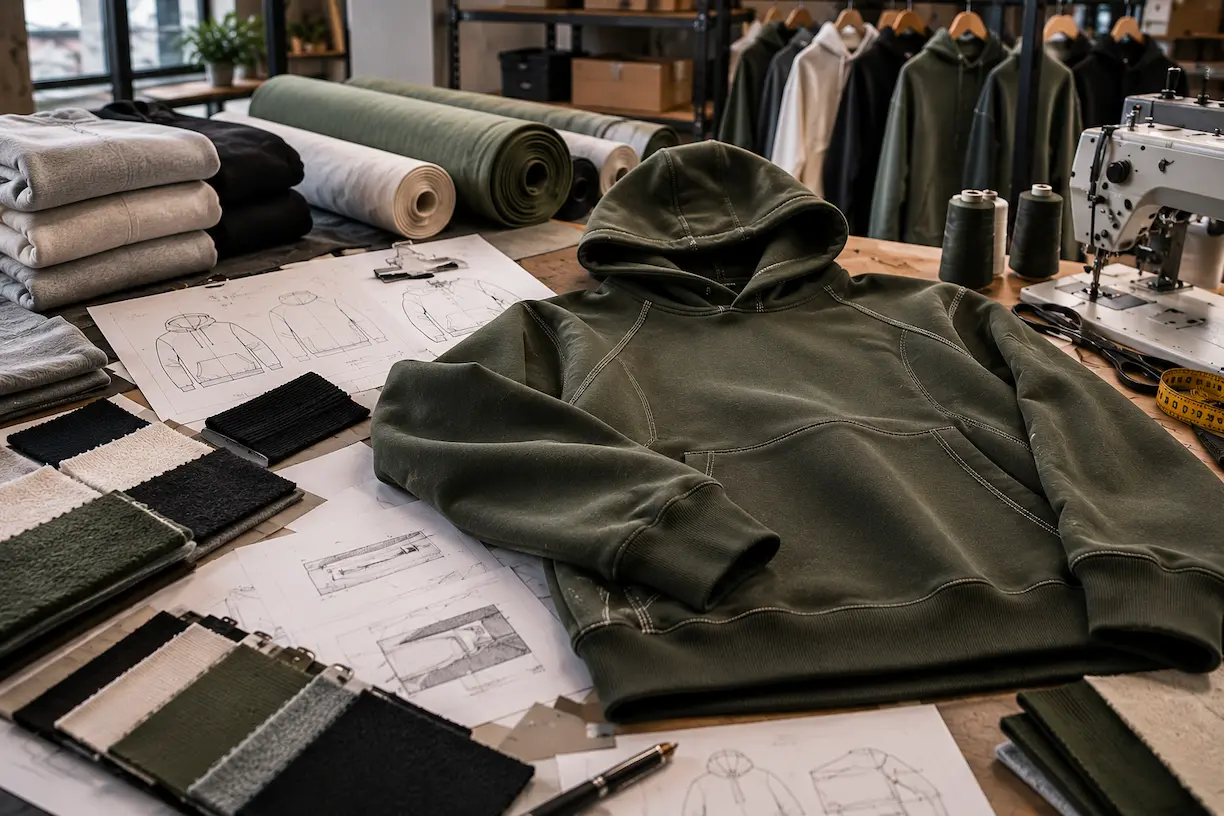
The ceiling on blanks is that every brand shopping the same catalogue gets the same garment. Cut and sew the ceiling:
- Proprietary fit. A cut that’s yours, adjusted from fit-model feedback and customer complaints. Competitors can’t buy it.
- Fabric weight and composition. A 450 gsm heavyweight fleece, a specific blend, an organic fiber, none of which exists as an off-the-shelf blank.
- Unusual silhouettes. Boxy crops, longline hems, asymmetric details, anything the standard blank catalogue doesn’t offer.
- Custom trims. Branded zippers, woven drawcord tips, custom labels, and hardware that make the garment feel designed rather than decorated.
- Full colorway control. Your exact Pantone-matched shade, not the nearest option from a fixed palette.
Together these are what turn a product into a brand. They’re also why brands that stay on blanks indefinitely often hit a differentiation wall: the only thing separating them from a competitor is a print anyone can replicate. If you plan to build a private label range with your own label, fit, and identity, this is where that work happens.
Signals You’re Ready for Cut and Sew
Don’t move on instinct. Move when your data says so. Here’s a checklist; if three or more apply, the move is probably justified:
- Strong repeat purchase rate. Customers who’ve bought once are buying again, which proves the product has a lasting audience.
- Consistent sell-through. A style sells through 70-80% or more of a run at full price, not through discounting.
- Fit complaints you can’t solve. Returns and reviews cite the blank’s cut, and you can’t change it.
- Margin pressure. Blank prices rise, or volume is high enough that cut and sew’s per-unit economics now match or beat blanks.
- Competitors on the same blank. Customers can find nearly the same garment elsewhere, and price is all that’s left to compete on.
- Volume to justify minimums. You can realistically sell a first cut and sew run, typically 100-300 units per style, without heavy discounting.
Watch the trend, not a single month. One strong quarter doesn’t prove repeat demand, but three consecutive months of climbing reorders from existing customers does. Keep a simple log of return reasons too: if “fit” or “fabric feels thin” keeps appearing, that’s customers telling you exactly what a apparel customization should fix.
If only one or two apply, stay on blanks a little longer. The cost of waiting is small, and the cost of moving too early is the $8,000 lesson from earlier.
How to Sequence the Move
The best-performing path is to validate first, then scale. Launch on blanks to prove demand. Identify the one or two styles with real repeat buying. Then take those proven styles into cut and sew, ideally matching the fit of the blank customers already love as a starting point, then improving it where the blank fell short. Your cut and sew clothing partner can reverse-engineer a reference garment, so the transition doesn’t mean starting from a blank page. It means moving a product with proven demand onto a platform you control.
Frequently Asked Questions
What do “cut” and “sew” mean in clothing?
Cut and sew is garment production from raw fabric up: pattern making, marker making, cutting, sewing, and finishing. It gives the brand full control over fit, fabric, and construction, unlike blanks, where those are fixed by the supplier.
Is cut and sew more expensive than using blanks?
At low volumes, yes. In the model above, a 100-unit hoodie run costs about 64% more per unit than blanks once development is included. By around 1,000 units the gap largely closes, and cut-and-sew often supports a higher retail price because the product is differentiated.
When should I switch from blanks to cut and sew?
When your data supports it: strong repeat purchases, consistent sell-through, fit complaints you can’t fix, margin pressure, and enough volume to justify minimums. Three or more of these together is a reasonable trigger.
What is the minimum order for cut and sew?
It commonly runs 100-300 units per style and colorway, driven by fabric roll and dye-lot minimums rather than sewing capacity. Consolidating colorways or using stocked fabric can bring it down.
Can I match the fit of a specific blank in cut and sew?
Usually yes. A factory can measure a reference garment and build a pattern that closely follows its fit, which you can then refine. Avoid copying a protected design, and treat the blank as a fit reference, not a template to duplicate.