Summary
A first clothing production run for 100 units typically takes 12–13 weeks from tech pack to shipment, not the 4–6 weeks most first-time founders assume. Sampling alone (proto, fit, and pre-production samples) commonly takes 4–8 weeks before bulk production even begins, and most garments need 2–4 rounds of sample revisions, not one. This guide maps every week, names the deliverable and approval owner at each stage, and shows exactly what to do when a stage slips.
The Launch Date That Was Never Real
Here’s how it usually starts: a founder picks a launch date, works backward, and assumes production takes four to six weeks, plenty of buffer, they think. Then sampling alone eats eight of those weeks, a lab dip nobody mentioned needs separate approval, and the “one sample round” they budgeted for turns into three. The launch date quietly becomes fiction sometime around week five.
This isn’t bad luck. It’s a planning gap. Every guide to “the clothing manufacturing process” describes the stages in the abstract, tech pack, sampling, production, and shipping, without ever putting them on an actual calendar with real dependencies. Nobody tells you what week 6 looks like who needs to approve what, or what specifically tends to break. Here’s that calendar.
The Full Timeline at a Glance
For a first 100-unit order of moderate complexity, say, a printed or embroidered t-shirt or hoodie, expect roughly 12–13 weeks from a finished tech pack to a shipped order. Simpler blank garments can move faster; heavily customized or multi-component styles can run longer. This timeline assumes your tech pack is complete and accurate before week one starts, because an incomplete tech pack is the single most common cause of delay industry-wide, responsible for a large share of all production hold-ups.
Weeks 1–2: Tech Pack Review and Quotation
Deliverable: A confirmed, priced quotation matching your finalized tech pack.
Approval owner: You, on final spec sign-off; the factory’s merchandiser on costing.
What happens: The factory reviews your tech pack, garment sketch, measurement chart, fabric details, print or embroidery placement, trims, and wash care and calculates fabric consumption, decoration cost, trims, and labor (making cost) to produce a final quote.
Most common failure: An incomplete or ambiguous tech pack. Missing measurements, unclear placement instructions, or unspecified trims force the factory to guess or pause and ask, and every round of back-and-forth here pushes every later stage back by the same amount. If you don’t have one built yet, this is exactly what a proper tech pack service exists to prevent.
Weeks 3–4: Proto Sample

Deliverable: A prototype, the first physical version of your garment, often made in substitute fabric, to validate the overall silhouette and construction.
Approval owner: You. This is your first real look at the design in physical form.
What happens: The factory’s pattern maker builds an initial pattern and constructs a sample to check the style translates correctly from sketch to garment.
Most common failure: Treating the proto sample as close to final. It isn’t, it’s a construction check, often in the wrong fabric, and design changes are still relatively cheap to make here. Founders who fall in love with a proto sample and skip straight to bulk thinking skip an entire fit-correction stage that exists specifically to catch problems now instead of across 100 finished units later.
Weeks 5–6: Fit Sample and Revisions
Deliverable: A fit sample, made closer to production specifications, to verify measurements and how the garment actually sits on a body.
Approval owner: You, ideally after a real fitting, not just a visual check on a hanger.
What happens: The factory adjusts the pattern based on your prototype sample feedback and produces a fit sample. This is almost never approved on the first pass; most products need 2–3 rounds for standard cut-and-sew and 3–4 rounds for more technical categories like activewear.
Most common failure: Assuming one round is enough, then being surprised when round two is needed. Budget the time for at least two rounds from the start, treating the second round as an unplanned delay, rather than a normal part of the process, is what turns a manageable schedule into a frustrating one.
Week 7: Lab Dips and Strike-Offs
Deliverable: A lab dip (a small fabric swatch dyed to your specified color, for approval before bulk dyeing) and a strike-off (a test print or embroidery swatch showing the actual color and stitch quality of your artwork).
Approval owner: You, and this is the single most-skipped approval step among first-time founders, per the pain points that drove this article.
What happens: Before your fabric gets dyed at bulk volume, or your artwork gets printed or embroidered at scale, the factory sends a small-scale test for sign-off. This exists because dye lots and print runs are expensive and difficult to redo; catching a color mismatch on a swatch costs almost nothing; catching it on 100 finished units costs the whole run.
Most common failure: Not knowing this step exists at all. Founders who’ve never done this before frequently don’t realize a lab dip or strike-off requires separate approval, assume “the sample was approved” covers it, and are blindsided when the bulk fabric or bulk print doesn’t match what they expected, because nobody actually signed off on the dye or the ink at scale.
Week 8: PP Sample and Sealed Sample
Deliverable: A pre-production (PP) sample, built using actual bulk fabric, approved trims, and approved print or embroidery, followed by a sealed sample, the final, formally signed-off reference garment that both sides agree represents the finished product.
Approval owner: You, in writing, before bulk cutting begins.
What happens: This is the last checkpoint before your fabric gets cut at volume. The PP sample should reflect everything approved so far: pattern, fit, color, and print combined into one garment. Once approved, it becomes the sealed sample: physically preserved, tagged, and dated, serving as the reference point for every unit produced in bulk and for any future reorder.
Most common failure: Rushing this stage to protect the launch date. Skipping or compressing PP sample review is one of the highest-cost mistakes in the entire timeline, errors caught here are inexpensive to fix; the same errors caught after bulk cutting can cost far more to correct than the time saved by rushing.
Weeks 9–11: Bulk Production
Deliverable: Finished, sewn garments cut, assembled, and decorated at full order volume.
Approval owner: The factory’s production and QC team, with visibility you should be requesting, not assuming.
What happens: Several distinct steps happen in sequence: grading (scaling your approved pattern across your full-size run), marker making (a CAD layout plan for cutting fabric with minimal waste), cutting (fabric cut according to the marker), and then the sewing line assembles the garment, with inline inspection quality checks during production, not just at the end, catching problems before they compound across the full run. Finishing (pressing, trimming, and labeling) follows once sewing is complete.
Most common failure, and the most commonly reported frustration overall: the factory going quiet with no status updates. Bulk production is the longest single stage, and it’s also the stage where communication most often breaks down, simply because there’s no natural checkpoint forcing an update the way sample approval does. Ask for a specific update cadence, weekly, at minimum, before production starts, not after you’ve already gone two weeks without hearing anything. If your order involves cut-and-sew work with multiple components, ask specifically for a mid-production status check with photos, not just a promise that “it’s on track.”
Week 12: Inspection and Packing
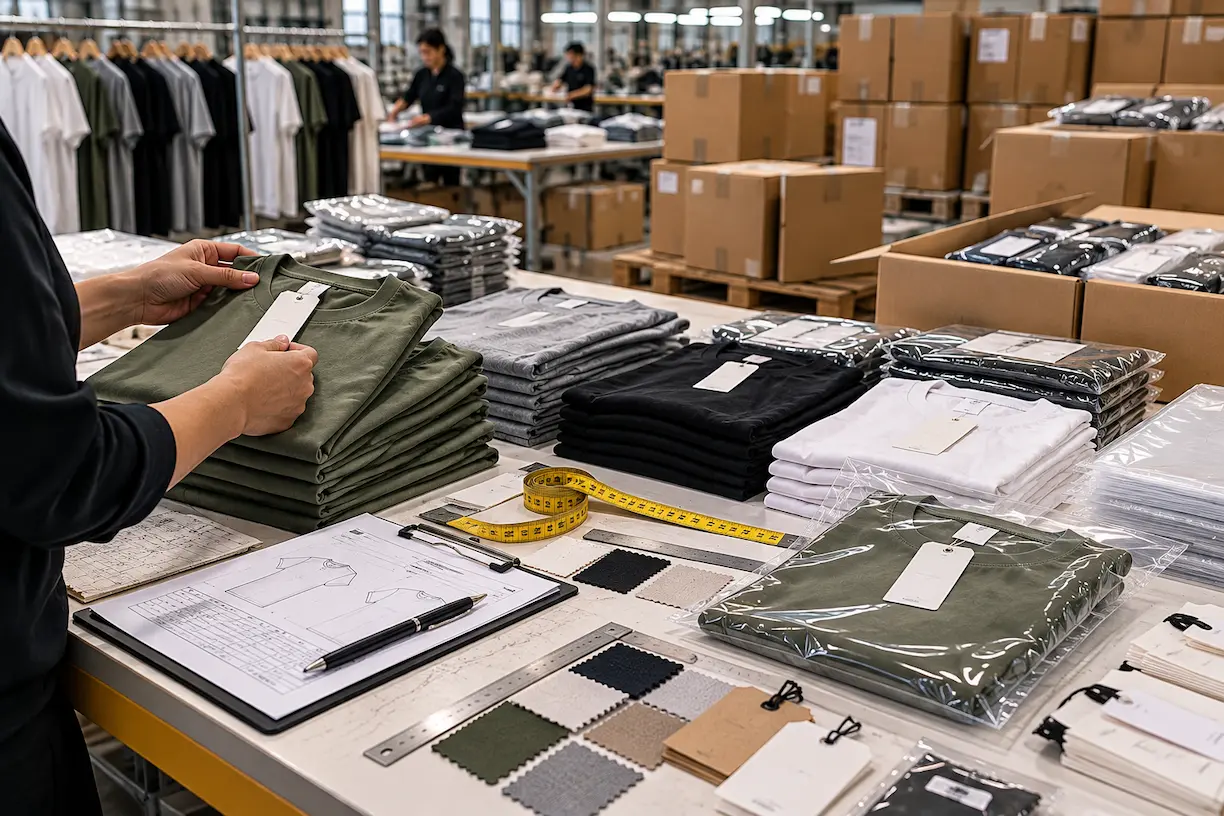
Deliverable: A completed final inspection report and packed, ready-to-ship goods.
Approval owner: You, or a third-party inspector acting on your behalf.
What happens: Final inspection checks finished garments against your sealed sample and tech pack, measurements, construction quality, color accuracy, and defect rate, typically using an accepted quality level (AQL) sampling method rather than checking every single unit. Approved goods then move to packing, including any clothing packaging, polybags, hangtags, folding, and cartons specified in your original order.
Most common failure: Skipping final inspection to save time or cost on a small order. A 100-unit run is exactly the size where a single undetected defect pattern can affect a meaningful share of your total inventory; this is not the stage to cut corners on.
Week 13: Ship
Deliverable: Goods in transit, with tracking and documentation in hand.
Approval owner: You, confirming shipping method and documentation before goods leave the facility.
What happens: Final payment (commonly the balance of a staged payment structure) is typically settled against shipping documentation, and goods move via your chosen freight method.
What to Do When a Stage Slips
Slippage is common, not exceptional; the goal isn’t avoiding it entirely, it’s catching it early and reacting deliberately instead of panicking.
If sampling is running long: Identify specifically which stage is stuck proto, fit, or lab dip/strike-off, and whether the delay is the factory’s or your own feedback turnaround. Slow buyer feedback is one of the most common, and most avoidable, causes of schedule slippage; a 48-hour commitment to reviewing and responding to samples protects your own timeline more than almost anything else in this article.
If fabric is delayed: Ask immediately whether an alternative in-stock fabric close to your original spec exists. Factories don’t start bulk production until materials are confirmed, so a fabric delay doesn’t just push that one step back; it holds the entire remaining schedule hostage until it’s resolved.
If the factory goes quiet mid-production: Don’t wait for the silence to break on its own. A direct, specific request, “can you send photos of current production status?” usually gets a faster, more honest answer than a general “how’s it going?” that’s easy to deflect with a vague reassurance.
If you’re genuinely at risk of missing a hard launch date: Have the conversation early, not in a week. 11. Rush options exist at nearly every stage of this timeline, but they carry real costs premiums and work best when requested with enough runway to actually help, not as a last-minute rescue attempt.
Build the Real Calendar Before You Announce a Date
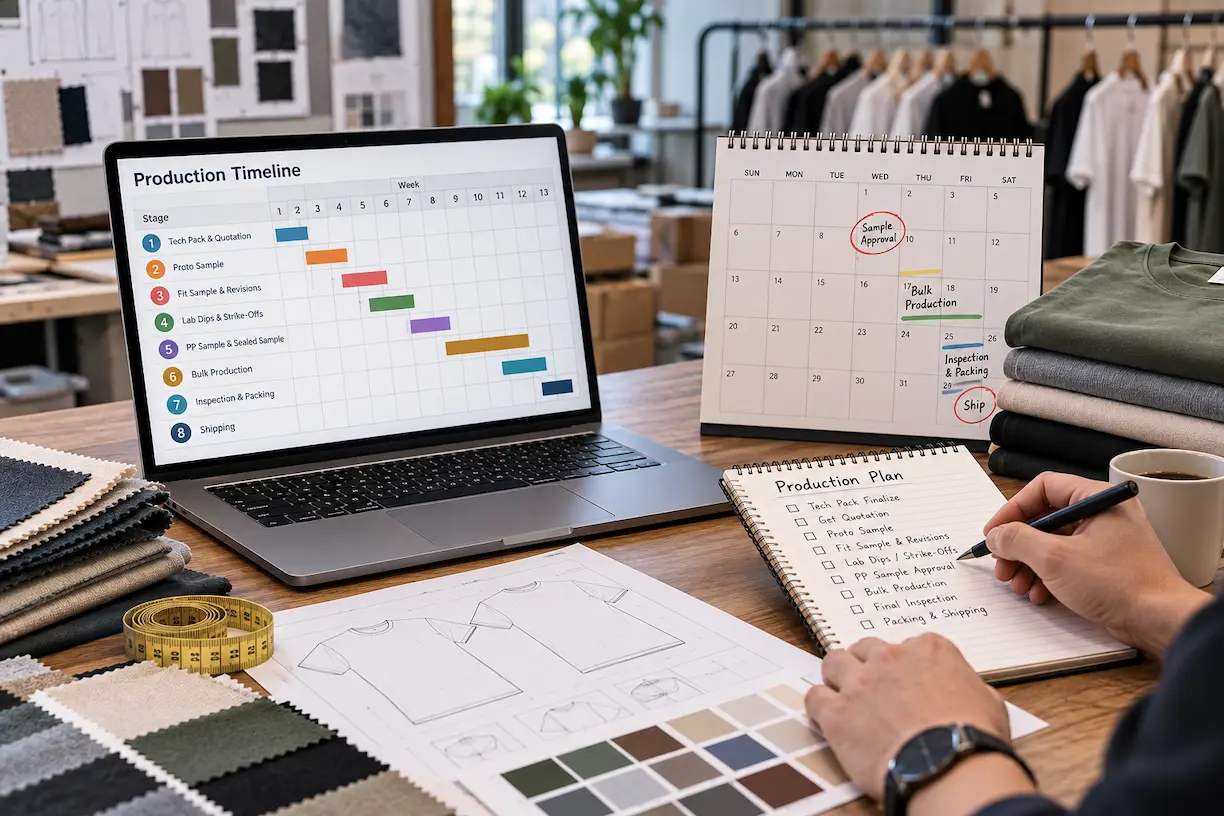
The founders who launch on schedule aren’t the ones who got lucky with a fast factory. They’re the ones who built their calendar around the real 12–13 week timeline from the start, budgeted for two sample rounds instead of one, and knew to ask about lab dips and strike-offs before being surprised by them.
Start with a complete tech pack, plan two fit sample rounds as the default, and insist on a specific communication cadence during bulk production before it begins, not after it’s already gone quiet.
Ready to run your first production timeline with real dates instead of guesses? Talk to Tack Apparel about mapping your specific 100-unit run, starting with a proper tech pack if you don’t have one yet.
Frequently Asked Questions
How long does it take to manufacture a clothing order?
For a first 100-unit order of moderate complexity, expect roughly 12–13 weeks from a finished tech pack to shipped goods; sampling alone (proto, fit, and pre-production samples) typically accounts for 4–8 weeks of that, well before bulk production even begins.
How many sample rounds should I expect?
Most cut-and-sew garments require 2–3 rounds of fit sample revisions, with more technical categories like activewear often needing 3–4 rounds. Budgeting for one round and being surprised by a second is one of the most common planning mistakes first-time founders make.
What is a pre-production sample?
A pre-production (PP) sample is built using your actual approved bulk fabric, trims, and print or embroidery, combining everything approved in earlier sample rounds into one garment. It’s the final checkpoint before bulk cutting begins, and once approved, it becomes the sealed sample used as the reference for the entire production run.
Why is my clothing order delayed?
The most common causes are an incomplete tech pack requiring back-and-forth clarification, slow buyer feedback on sample approvals, fabric or trim sourcing delays, and skipped approval steps like lab dips or strike-offs that surface as mismatches later. Bulk production itself is also the stage most prone to communication gaps if a specific update cadence isn’t agreed upon upfront.
Can I produce only 100 units of a design?
Yes, with a manufacturer whose minimum order quantity supports it, 100 units is a common small-batch production size for cut-and-sew apparel. The full development timeline (tech pack, sampling, approvals) applies at any order size, so a smaller unit count doesn’t meaningfully shorten the weeks spent on sampling and approvals, only the bulk production window itself.